Schoolboy, Servant, GWR Apprentice
The memoirs of Alfred Plumley, 1810 - 1892
On a cold, thoroughly miserable afternoon in January 2014, in scarf and woolly hat, my warm coat zipped up, I was rooting around in the lots for sale at an auction saleroom on the Dorset coast. The wind howling off the sea rattled the windows. It felt colder indoors than outdoors.
After about half an hour, I was beginning to wish I'd not bothered coming, Then I picked up a creased cardboard folder, clearly some decades old. It contained maybe a hundred typewritten sheets held together in small batches by rusted staples. The paper was tatty and discoloured. The wonky lines suggested that the typewriter's best days were already behind it when the typescript was made. As my cold-numbed fingers turned the pages, the document was revealed to be a memoir of some kind, written by an elderly gent recalling his rural childhood and adolescence. At the sale the following day, a single bid of £20.00 was enough. I was the only buyer interested.
That evening I sat down to read the memoir. The bare bones of it are easily summarised. It was written in the first person - but anonymously. It described the life of a boy growing up in a village in the Mendip Hills in Somerset in the last quarter of the 19th century. It began with the writer's first day of school at the age of five. Just after his twelfth birthday, his schooldays came to end and he went immediately into service as a page-boy at the " big house" nearby. At sixteen, with the help of the kindly lady of the house who wanted to encourage him into a trade, he took up a station staff apprenticeship with the Great Western Railway (G.W.R.). He was placed at a tiny village station, just inland from the Somerset coast. When the writer turned eighteen in 1892, his job with the G.W.R. was confirmed as permanent - and at that point the story ended. The memoirist assured the reader though, that he went on to become a successful railwayman. His entire working life was to be spent with the G.W.R..
The typescript itself was undated but piecing together the clues, it was possible to work out that it had been written between 1954 and 1956, when the author was in his early eighties. But who was he? He named himself just twice in the 40,000 words of text, on both occasions reporting other people speaking to him. The first time he referred to himself only by the forename, "Alfred". The second time - in reference to his surname - only by the initial "P". The places where the he lived, went to school and worked were all given fictitious names - a little deceit that dawned on me only after I'd wasted half an afternoon poring over maps of Somerset. Worse still, because the place names were invented, there was of course, also the possibility that that "Alfred", and/or that surname initial "P", were also fabrications. It could easily have been that the memoirist would prove impossible ever to identify. If that had been the case, of course, then I could never have written my book. On page 84 of the typescript however, there was a crucial five digit number. This number - 15718 - proved to be the secret code that would unlock the mystery. It was the number that appeared on the writer's wage slip every week for forty-five years; the number that just possibly might give him a name. It was his G.W.R. staff number.
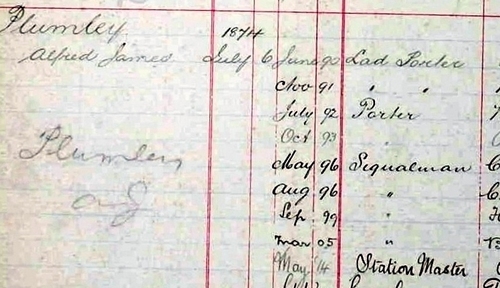
Alfred's entry in the G.W.R. staff ledger; the key to the whole story.
The staff records of the G.W.R going back to the middle of the nineteenth century are stored at the National Archives in Kew. The records were not written down sequentially by staff number, so the only way to find our man was to look up every individual "Alfred" who started work with the G.W.R. in the later 1880s or the early 1890s. After I'd ploughed through the first fifty or sixty ghosts of Victorian engine drivers and stokers, signalmen, porters, booking clerks, fitters and coachbuilders named Alfred, the number in the right hand column of the staff records suddenly matched the number in my notebook. There, blinking in the sunlight, after more than a century shut flat in the G.W.R. staff ledger, was the author of the memoir, Alfred James Plumley himself.
A quick reference to the 1881 census records revealed the very same Alfred James Plumley, then a "scholar" aged six, the son of a coachman, living in Lower Langford, a village in the Mendip region of Somerset. It was amazing just how much detail flowed from this first discovery. Alfred's manuscript did not give any real names, even to members of his own family - but public records of the period allowed me to identify them. Likewise I was able to give names to some of the village characters whom Alfred mentions. I was even able to identify the two grand houses at which Alfred worked as a servant by cross-referencing Alfred's clear written descriptions with old photographs of the local area. Gradually, an entire cast of real-life characters emerged to populate Alfred's story.
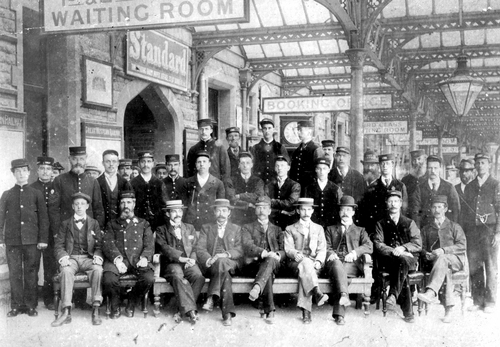
Station staff at Weston-super-Mare Station in the early 1890s. Alfred's first G.W.R. job (1891 - 1893) was at a village station just two miles up the line.
For Alfred, the past is a good place. His family is a happy and loving one. His mother is kind, his father is hard-working and respected in the village. Somerset's summer skies are always blue. Somerset's winter landscape glitters white with frost. The Mendip Hills are endlessly beautiful and the tumbling streams are crystal clear. His pals at school are boisterous and fun-loving, like small boys should be. When he goes to work at the big house, the playful maids treat him like their favoured little brother and the butler turns out to have a Jeeves-esque range of endearing hidden talents. When his G.W.R. apprenticeship calls for him to move away from home, his landlady is motherly, the station at which he works buzzes with cheerful rural activity and his station master proves to be a wise and benevolent man.
Schoolboy, Servant, G.W.R. Apprentice takes a gentle stroll through Alfred's life, from the day he started school in 1879, to the day in 1892 when he became, officially and permanently, in his own words, "a uniformed servant of the mighty G.W.R.". Alfred's prose style is simple - almost conversational - but always expressive and engaging. He describes village life vividly and the Mendip landscape with great affection. His memories are full of human interest and of course, well over century on, the historical detail is fascinating.
Schoolboy, Servant, GWR Apprentice is published by History Press.
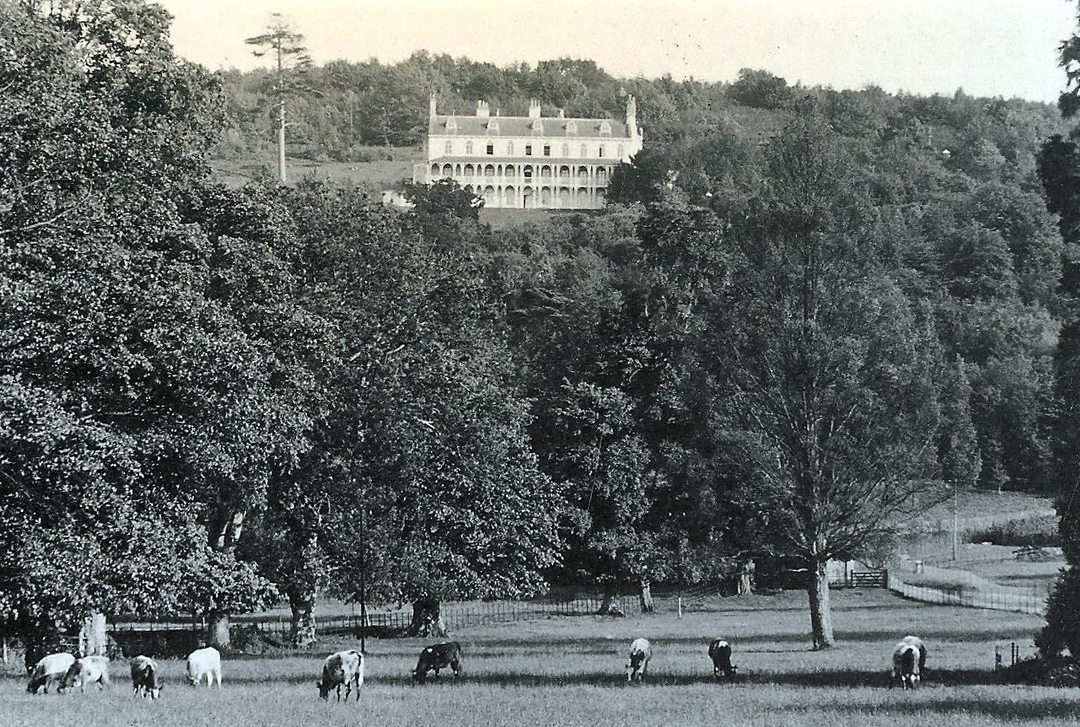
Mendip Lodge (since demolished), one of two grand houses locally where Alfred was employed as a servant.